

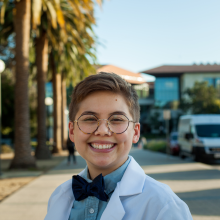
Kit Vodehnal
Neurosciences PhD Candidate, Stanford University
Neuron-glia interactions in regulating protein aggregation in human cell models.
Bio
Kit Vodehnal is a fifth year PhD candidate in the Neurosciences IDP who is conducting their thesis research in the lab of Dr. Marius Wernig. They received their B.S. in Biological Engineering with a concentration in Neurobiology from MIT in 2020. In the Wernig lab, Kit leverages the lab's cell reprogramming and co-culture techniques to study the roles of individual cell types in proteinopathies. They aim to faithfully recapitulate disease states and uncover the underlying molecular mechanisms that lead to neurodegeneration.
Abstract
There is one shared characteristic of all neurodegenerative diseases: the accumulation and aggregation of abnormal proteins in the patient’s brain. These aggregations are thought to induce neuronal cell death and brain degeneration. Therefore, it is plausible that blocking protein accumulation or enhancing the clearance of aggregates would have a beneficial therapeutic effect. Microglia, the brain’s immune cells, have been suggested to play a role in the accumulation/clearance of these proteins, but their exact role and the mechanisms by which they interact with pathogenic aggregations remains unknown. To tackle this question, we established a cell culture system consisting of human stem cell-derived neurons, astrocytes, and microglia. Remarkably, we observed robust formation of large, spheroid a-synuclein inclusion bodies in neuronal somata as well as elongated aggregates in neurites when seeded with pre-formed fibrils. The recapitulation of this critical pathological feature in our defined tri-lineage human cell models now opens the opportunity to investigate cellular mechanisms such as the contribution of microglia to aggregate formation.

Birgitt Schuele
Associate Professor of Pathology, Stanford University
Neurodegeneration across Borders: Resilience, Fieldwork, and Gene Therapy
Bio
Birgitt Schuele, MD, is an Associate Professor of Pathology and, by courtesy, Neurology at Stanford University School of Medicine whose research integrates medical genetics and human stem cell modeling to uncover mechanisms of neurodegeneration in Parkinson’s disease and related disorders to advance precision therapeutic strategies. She received her medical training and medical thesis in neurophysiology at Georg-August University Göttingen and trained in neurology at the Medical University of Lübeck before completing a postdoctoral fellowship in human genetics at Stanford University with Uta Francke. From 2005–2019, she led research programs and built key biospecimen repositories for neurogenetics, translational stem cell research, and brain donation at the Parkinson’s Institute and Clinical Center. She currently serves as Associate Core Leader for Neuropathology and the Research Education Component (REC) in the Stanford Alzheimer’s Disease Research Center, where she established a stem cell program and tissue bank, shared with public repositories to enable broad collaborative research.
Abstract
The Schuele lab advances an integrated neurodegenerative disease program that connects mechanisms of resilience and vulnerability across Alzheimer’s disease, Parkinson’s disease, and ataxia disorders. Two Knight-funded initiatives anchor this work: The APOE4 resilience program asks why a subset of APOE4 carriers remains protected from cognitive decline, using deeply phenotyped human iPSC-derived neuronal and glial models to pinpoint resilience-associated pathways in lipid biology, endolysosomal function, and cellular stress responses, and to prioritize targets for future functional testing. In parallel, the Parkinson’s gene therapy program develops immune-optimized AAV-based strategies to safely and durably modulate key drivers of synucleinopathy, integrating human iPSC co-culture systems and in vivo models with molecular and pathology readouts to accelerate clinical translation. Complementing these efforts, the lab leads an international effort to resolve ATXN10 repeat expansions across South America, applying long-read sequencing and genome mapping to define repeat architecture, motif interruptions, and genotype–phenotype relationships. Across all three pillars, we focus on convergent neurodegenerative biology to move from genetic insight to mechanistic validation and therapeutic intervention.
CLICK TO DOWNLOAD EVENT POSTER
About the Series
The Knight Initiative for Brain Resilience hosts monthly seminars to bring together grant awardees, affiliated professors and students for a series of 'lab meeting' styled talks. Two speakers will discuss their brain resilience research, experiences in the field, and answer questions about their work.
To support our researchers' participation in this open science ‘lab-meeting style’ exchange of ideas, these seminars are not streamed/recorded and are only open to members of the Stanford community.