

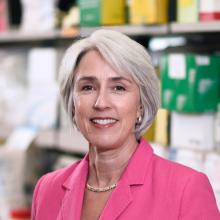
Margaret ("Peggy") Goodell
Professor and Chair, Department of Molecular and Cellular Biology, Baylor College of Medicine
Somatic Mosaicism and Aging: Cause, Consequence, or Clock?
Bio
Margaret (“Peggy”) Goodell is Professor and Chair of the Department of Molecular and Cellular Biology, and Director of the Stem Cells and Regenerative Medicine Center, at Baylor College of Medicine, in Houston, Texas. Goodell’s research is focused on the mechanisms that regulate blood-forming stem cells and their dysregulation during aging. Goodell is a member of the National Academy of Sciences, the National Academy of Medicine, and the American Academy of Arts and Sciences. Goodell served as president of the International Society for Experimental Hematology, was a recipient of the Damashek Prize from the American Society of Hematology, the Edith and Peter O’Donnell Award in Medicine from TAMEST, and the Tobias Award from ISSCR. Goodell directs a laboratory of about 15 trainees.
Abstract
With age, mutations accumulate in all cells, drive intercellular competition, and ultimately lead to the evolution of the cellular landscape within tissues. This somatic mosaicism and tissue evolution is ubiquitous within aging individuals. Somatic mosaicism has been most extensively studied in the blood, where cellular “winners” commonly harbor mutations in genes controlling epigenetic regulation or DNA repair. The Goodell lab studies how mutations in these genes confer a cellular advantage in the aging milieu, and how these changes in turn promote aging, with broad organismal consequences.
About the Series
This collaborative seminar is a joint effort of the Knight Initiative for Brain Resilience and the Paul F. Glenn Center for Biology of Aging Research.
To support our researchers' participation in this open science "lab-meeting style" exchange of ideas, these seminars are not streamed/recorded and are only open to members of the Stanford community.