

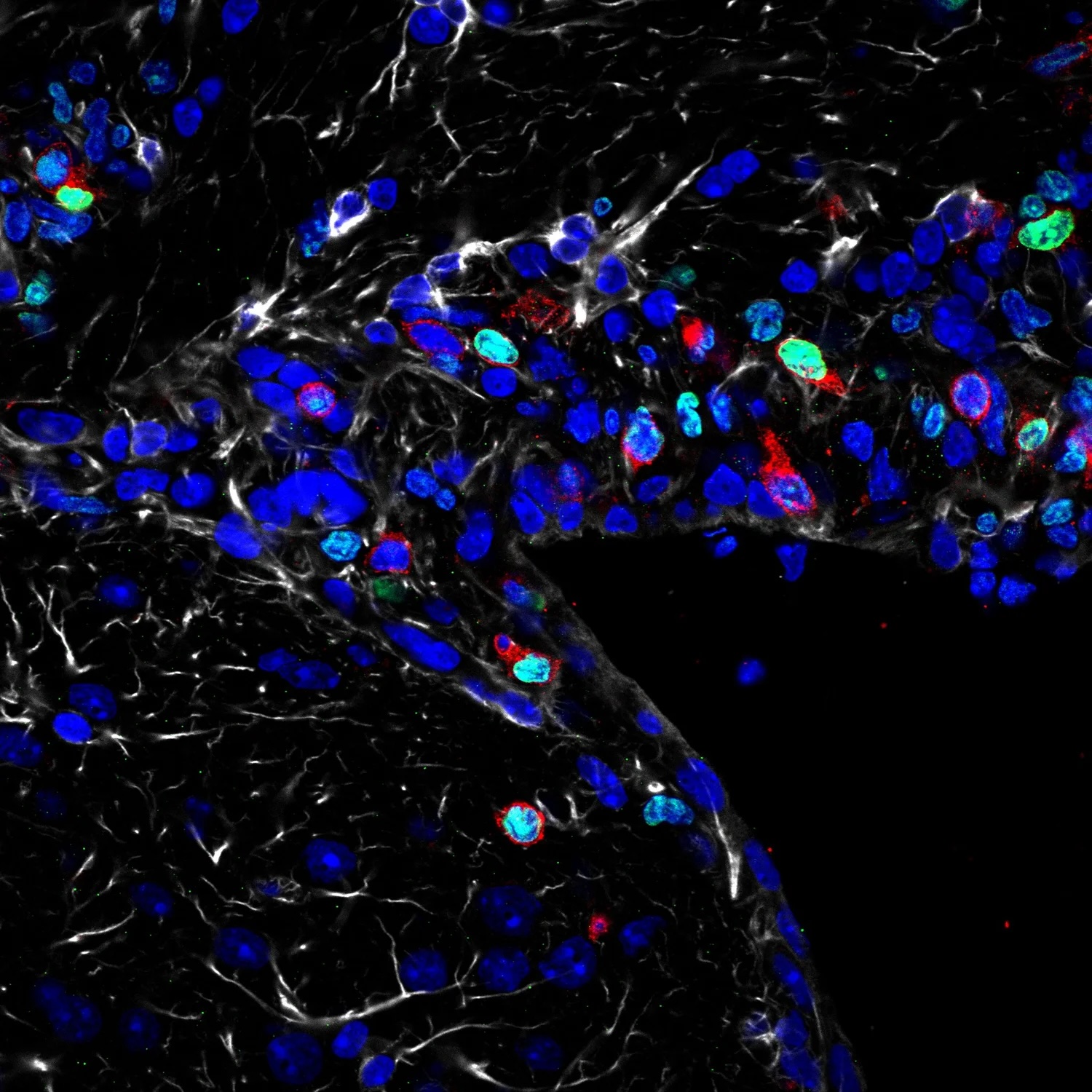
Researchers with the Knight Initiative for Brain Resilience have modified a well-known immune protein to spark the growth of new neurons, ease brain inflammation, and improve cognition in old mice.
The findings, published February 10, 2026 in the journal Immunity, could open new avenues for understanding and treating neurodegenerative diseases in humans.
Those conclusions emerged from a collaborative Knight Initiative Innovation Award project aimed at understanding the source of aging-related inflammation in the brain and how to eliminate it, said senior author Anne Brunet, the Michele and Timothy Barakett Professor of Genetics at Stanford Medicine.
“We illuminate the complex relationship between the aging immune system and cognitive function,” said Brunet, a Wu Tsai Neurosciences Institute affiliate. “We hope this study could one day lead to immunotherapies for Alzheimer’s, Parkinson’s and other age-related neurodegenerative diseases of the brain.”
First author Paloma Navarro, a postdoctoral fellow in Brunet’s lab, was inspired by earlier studies showing that—contrary to the old dogma that the brain is protected from the immune system by the blood-brain barrier—immune cells known as T cells often infiltrate aging brains. Those studies also showed that many of these T cells have grown “exhausted” as they age and can’t perform as well as they once did.
To re-energize old brain T cells, the researchers first identified a chemical signature of T cell exhaustion in mice, then gave them a protein that inhibits this exhaustion and makes the immune cells healthy again. One result was to induce inflammation in microglia—the "trash collectors" of the brain, which are responsible for removing damaged, infected, or dysfunctional cells.
Brunet theorizes that as microglia get inflamed they can no longer pick up the trash. If true, the aging brain would grow cluttered with damaged or diseased cells, leading to even more chronic inflammation and impaired cognition.
The researchers then went a step further to investigate inflammation in old brains, focusing specifically on the role of a protein known as Interleukin-10 (IL-10). IL-10 has both pro- and anti-inflammatory effects on microglia, so the team sought to tip the scales by isolating the anti-inflammatory effect of IL-10.
With support from an Innovation Award from the Knight Initiative for Brain Resilience, Brunet struck up a collaboration with the lab of Christopher Garcia, the Younger Family Professor of structural biology and a professor of molecular and cellular physiology at Stanford Medicine. In a remarkable feat of biochemical engineering, Garcia’s team was able to create a version of IL-10 with only beneficial, anti-inflammatory properties.
“Chris did some beautiful work engineering this anti-inflammatory IL-10,” Brunet said. “And we were rewarded when we saw that it both improved cognition and promoted the growth of new neurons in the brains of old mice. We really wanted to quench the inflammation and the engineered IL-10 worked great.”
Indeed, when the team administered this modified IL-10 to old mice, they found evidence of newly formed neurons, and they found that old mice performed better on a battery of cognitive tests, including navigating mazes, recognizing novel objects, and nest-building skills that typically decline with age.
"The overarching theory here is that inflammation is causing decreased neurogenesis and that by reducing inflammation, we can improve brain function," Brunet explained. “This work is exciting because it pinpoints specific elements of the immune response that can be altered to benefit brain health, providing a new avenue for immunotherapeutic intervention.”
Next up, Brunet and team plan to refine their approach and better target it to specific cell types. This might involve developing even more specific immune targets and other immune-modulating proteins to fine-tune the immune response with fewer—or, perhaps, no—side effects.
Navarro, the postdoctoral fellow leading the work, has now started her own laboratory at Ecole Polytechnique Fédérale de Lausanne in Switzerland, where she will continue to work on IL-10 and other immune proteins in her own lab.
“The ultimate goal will be translating these promising findings to humans,” Brunet said. “Immunotherapies could revolutionize the treatment of neurodegeneration and cognitive decline as they have for cancer.”
Publication Details
Research Team
Study authors were Paloma Navarro Negredo, Justin You, Max Hauptschein, Daniel J. Richard, Eric D. Sun, Giulia Notarangelo, Julliana Ramirez-Matias, Matthew T. Buckley, and Lucy Xu from the Department of Genetics at Stanford Medicine; Gita C. Abhiraman from the Department of Molecular and Cellular Physiology and the Medical Scientist Training Program at Stanford Medicine; Olivia Y. Zhou, Karen E. Malacon from the Department of Genetics and the Medical Scientist Training Program at Stanford Medicine; Andy P. Tsai, Eduardo Ramirez Lopez, and Tony Wyss-Coray from the Phil and Penny Knight Initiative for Brain Resilience and the Wu Tsai Neurosciences Institute; Lora Picton, Robert A. Saxton, and Ricardo A. Fernandes from the Department of Molecular and Cellular Physiology at Stanford Medicine; Christopher Garcia from the Department of Molecular and Cellular Physiology and the Department of Structural Biology at Stanford Medicine, the Howard Hughes Medical Institute, and the Phil and Penny Knight Initiative for Brain Resilience; Anne Brunet from the Department of Genetics at Stanford Medicine, the Phil and Penny Knight Initiative for Brain Resilience, the Wu Tsai Neurosciences Institute, and the Glenn Center for the Biology of Aging at Stanford University; and Adam B. Schroer, Juliana Sucharov and Saul A. Villeda from the University of California, San Francisco.
Research Funding
The research was supported by the NIH (S10RR025518-01, S10RR027431-01, S10OD026831-01, and NIH R01AG071711); a gift from T. and M. Barakett; CZI inflammation grant; a Knight Initiative for Brain Resilience Innovation award; the Simons Foundation; the NIA (AG077816, AG064823, and AG086042); a Wellcome Trust Sir Henry Wellcome Fellowship (WT101609MA); a Chinese Academy of Medical Sciences Innovation Fund for Medical Science Grant (2018-I2M-2-002); and a Human Frontiers Science Program Long-Term Fellowship.
Competing Interests
Garcia and Fernandes are inventors on a patent involving RIPR-PD1 (WO2019222547A1). Garcia and Saxton are inventors on a patent involving IL-10 (WO2021243057A1). Garcia is the founder of Synthekine Inc. Brunet is on the Scientific Advisory Board of Calico Labs.