

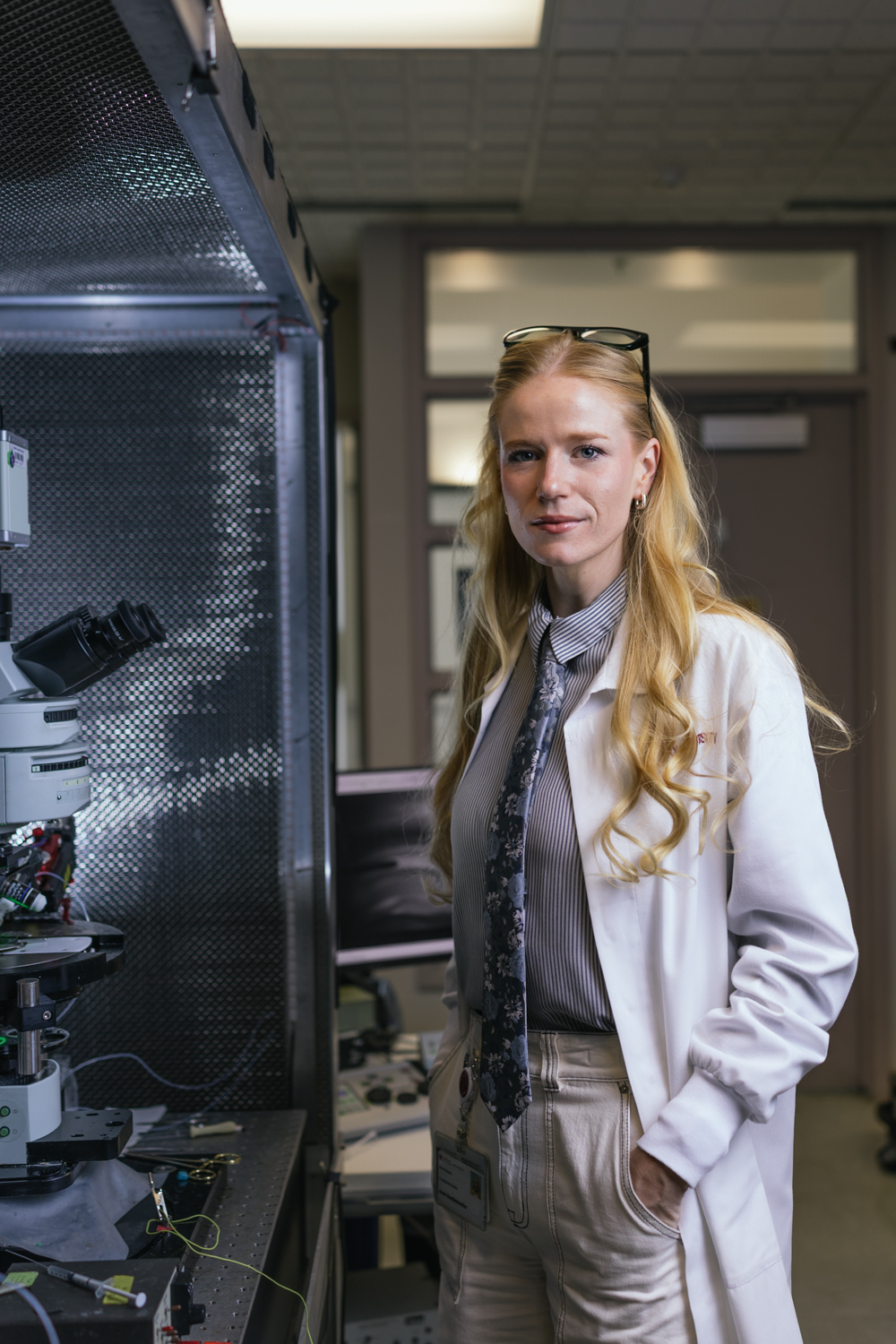
When Annie Goettemoeller first started working on Alzheimer’s, many of her colleagues were focused on the buildup of amyloid and tau proteins in and around neurons. The going theory at the time was that targeting those might help slow or even reverse cognitive decline.
But Goettemoeller, a Wu Tsai Neurosciences Institute Postdoctoral Scholar supported by the Knight Initiative for Brain Resilience, became interested in a different question: What are the earliest changes that happen in the Alzheimer’s brain, and could understanding those changes point toward prevention? That curiosity led her to explore an unexpected overlap with a seemingly unrelated disorder: epilepsy.
Now, Goettemoeller’s research in the lab of Ivan Soltesz, a professor of neurosurgery at Stanford Medicine and Wu Tsai Neuro affiliate, investigates how Alzheimer’s alters the brain’s electrical activity—and how those changes may interact with the spread of pathological amyloid and tau proteins, long before severe symptoms appear.
Her project comes at a particularly opportune time: While drugs that bust up amyloid plaques have proven only modestly successful, it’s increasingly clear that Alzheimer’s is complex and treating it likely requires multiple approaches.
We sat down with Goettemoeller to talk about her research and her long-term goal of contributing to preventative strategies.
What got you interested in studying how Alzheimer’s disease begins?
What initially drew me in was the idea of prevention. Early in graduate school, I think I was a bit naive. I thought perhaps there might be a single root cause of Alzheimer’s disease. But over time, it’s become clear that the disease is far more complex. There are genetic factors, lifestyle factors, and likely many interacting pathways that contribute to risk.
So instead of searching for one root cause, I became interested in identifying early changes in brain circuits that might be shared across many patients. If we can understand those early events, perhaps we can intervene before the disease progresses.
A lot of Alzheimer’s research focuses on plaques or on molecular processes inside cells, but you’re focused more on electrical signals. Why is that?
Back in 2012, Lennart Mucke's lab at the Gladstone Institute of Neurological Disease did this retrospective study of Alzheimer’s patients, and the first author, Keith Vossel, realized that many of the patients had these big electrical discharges in their brains that are typically characteristic of epilepsy. Importantly, some of this activity appears before patients are diagnosed with Alzheimer’s and before severe pathology develops. We see this in mouse models as well, long before severe pathology arises, before plaques build up.
Not all of these patients have seizures. Instead, many show what’s called subclinical epileptiform activity. This reflects hyperexcitability in brain networks. In simple terms, some neurons begin firing more often than they should. Because brain circuits are highly interconnected, that increased activity can affect nearby neurons and alter the normal balance of signaling. And even without obvious seizures, that kind of altered activity may interfere with memory and cognition.
Is that hyperexcitability related to how Alzheimer’s pathology spreads in the brain?
That’s one of the key questions. We know that certain regions are vulnerable very early in Alzheimer’s disease. One of them is the entorhinal cortex, which plays an important role in memory and navigation. It’s also one of the first places where we see tau pathology.
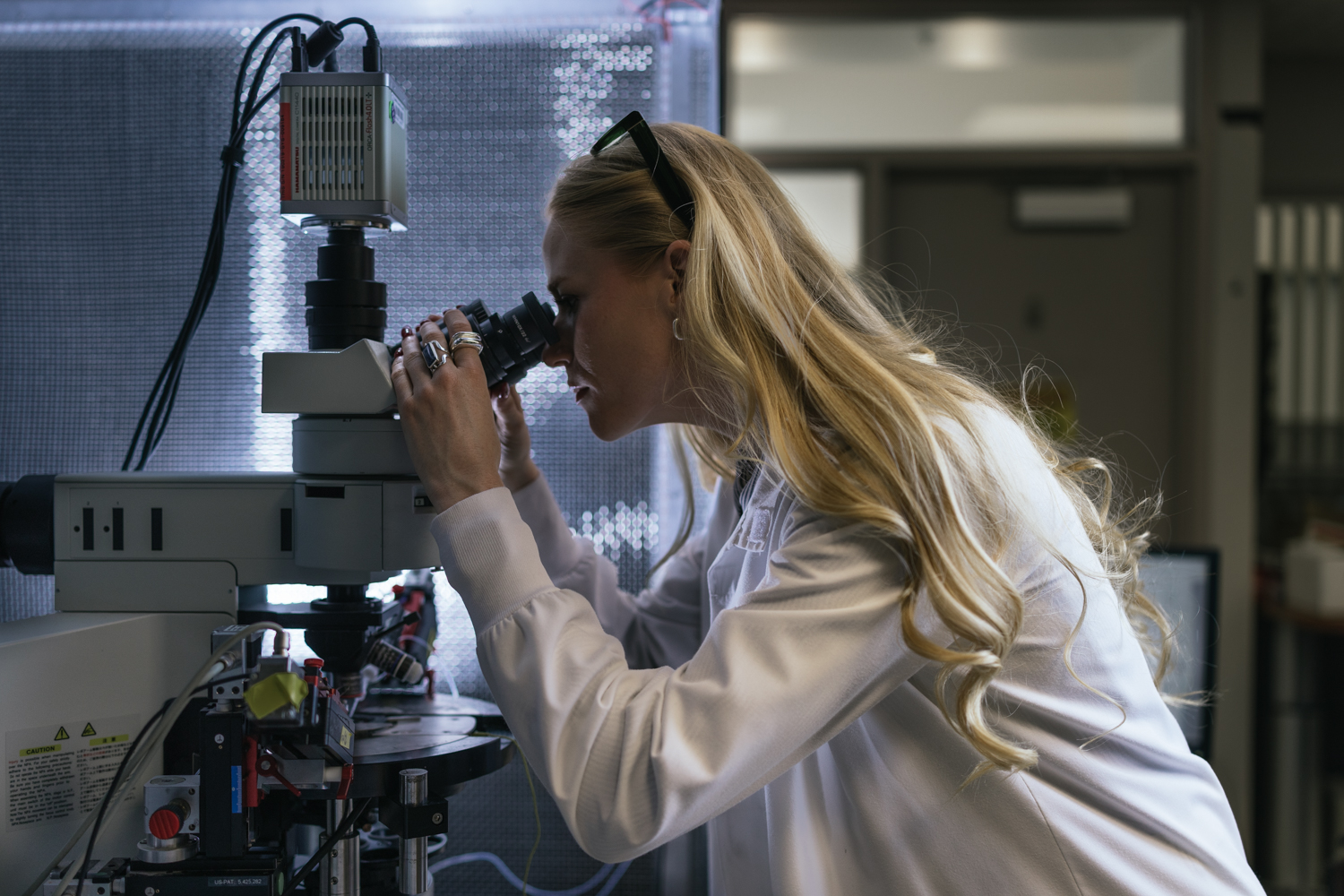
There's also work from Karen Duff's lab at University College London and Scott Small's lab at Columbia where they show that if you trigger hyperexcitability in the entorhinal cortex, tau pathology spreads beyond the entorhinal cortex.
At the end of my PhD, I was looking specifically at what within the entorhinal cortex might make it vulnerable, and we also saw the entorhinal cortex is uniquely susceptible to early hyperexcitability, which in turn can drive more severe pathology.
So there appears to be a relationship between abnormal electrical activity and disease progression. What’s less clear is how that relationship works mechanistically.Now, what I’m interested in is how changes in the entorhinal cortex influence downstream regions like the hippocampus.
How are you going about answering those questions?
I’m studying the communication between the entorhinal cortex and a part of the hippocampal formation called the dentate gyrus, which is critical for memory.
Under normal conditions, the entorhinal cortex sends input to the dentate gyrus in the form of large, coordinated electrical events known as dentate spikes. These events are part of normal brain function and are important for learning and memory, as our lab has recently shown.
What we’re investigating is how those events change in the early stages of Alzheimer’s disease. Do they become exaggerated? Do they diminish? Could they transform into more pathological events? Or is something else happening entirely?
One important caveat is that when we see something change in disease, it’s tempting to assume it’s harmful. But the brain tries to adapt. What looks abnormal could in some cases be a compensatory response. If we were to block that change without fully understanding it, we might unintentionally make things worse.
That’s why basic science is so important. Before we try to intervene, we need to understand what these changes actually represent.
I know that you’re also working with other researchers at Stanford on this. Can you tell me a bit about who you’re collaborating with and why?
Yes. I’m collaborating with Alice Ting, whose lab has developed tools that allow us to manipulate specific neural connections with much greater precision.
Traditionally, if you wanted to study what happens when the entorhinal cortex’s connection to the hippocampus is disrupted in a mouse, you might simply silence those neurons. But that approach affects all of their projections throughout the brain.
What this tool from the Ting lab helps us do is specifically cut out the connection between the entorhinal cortex and these particular dentate gyrus cells.
Then we can ask, for example, what happens if we disrupt that connection in a healthy mouse, do we see memory changes that resemble aspects of Alzheimer’s? And in a mouse model of Alzheimer’s, if we modify that connection, do we see improvement—or worsening?
We don’t yet know the answers. But those experiments will help clarify whether this circuit is contributing to pathology or attempting to compensate for it.
What do you hope will come of your research?
Even some of our early findings have been surprising, and relevant not only to Alzheimer’s disease, but to epilepsy as well.
In the near term, our goal is to understand whether repairing or stabilizing this circuit can reduce cognitive decline in mouse models. Longer term, I’m interested in how abnormal electrical activity and molecular pathology influence one another in the earliest phases of disease.
Ultimately, like most scientists, I hope that by understanding these early mechanisms, we can contribute, one piece at a time, to strategies that help prevent Alzheimer’s disease.